Materializing the Prosthetic Self

Current techno-cultural discourse seems to be stuck on an old fantasy: escaping your physical body. The buzzwords change their names but the script stays almost the same. Upload your mind and consciousness. Move your life into a frictionless metaverse. Keep existing after your physical death.
Human body seems to exist only as a temporary dock that is unfortunately still needed for information-processing systems to operate. The future is sold to us with bells and whistles as an upgraded path you should most definitely desire. And at the same time it treats our physical bodies as outdated hardware that the system is forced to tolerate.
Erasing the Body by Design
This makes it a design problem today and not some hypothetical glitch in the future. When bodies are framed as obsolete, design surely follows. Design practices that rely on situated, bodily and yes, a bit messy, human experience are pushed aside. The user becomes some abstract entity that clicks, swipes and accepts cookie banners. There's no body with its sweat and weight, or awkward postures in the experience mix. Just these imaginary weightless users drifting through a grid where nothing ever lags or pushes back.
This is precisely what N. Katherine Hayles warned about in How We Became Posthuman: the "erasure of embodiment" that occurs when information is privileged over material instantiation. Hayles also argues that embodiment is not accidental, it's constitutive of thought itself. (1999)
As a designer I'm drawn to what happens if we ignore the ideal weightless user that navigates latency-free systems with ease. What if we would turn our focus on the one who limps a bit and who tinkers and tweaks their own DYI add-ons, a bit of duck-tape here and there, just to make the official solutions work for them when they fail.
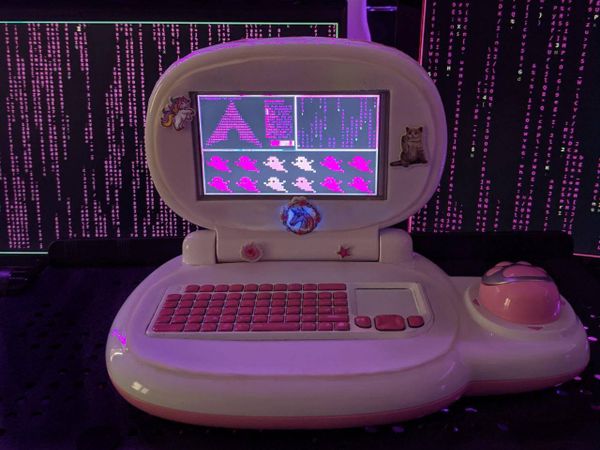
Maybe it’s because I grew up with a different version of the future human. Everything had cables hanging out and we had buttons that physically clicked. Thats probably why our early cyborg visions were also rough and perhaps a little naive, but they did admit that bodies and tools rub against each other. They leave marks that could seen and felt. And remembered.
It feels like every time we design "immersion" today, we also quietly try to erase the body. We don't want to factor in the body nor the experience that is lived and felt throug it. We seem to work really hard to make the human step aside and let the tech do everything better and faster.
We design AI assistants to have multiple answer versions before your own memory even gets the chance to think about the question. All the "smart” spaces around us try to predict every move we make and any pause or hesitation we have feels like an error in that system. Error that needs to be eliminated as fast as possible. It’s as if having a body and being slow or unsure is treated like a glitch that needs to be removed.
Designing Against Disembodiment
So I like to work in the opposite direction. Instead of trying to remove or ignore the body, I want to treat the body as the very first interface that needs iterative prototyping. Not in the Silicon Valley “biohacking” sense of way where the main goal is efficiency and eternal life, but as a practice of noticing and testing how it actually feels to be here with our limits and frictions. And when you have decide to keep the body in focus, making tangible artefacts becomes a way to ask better questions.
This is where design fiction becomes useful and not so much as storytelling tool but as a useful tool to generate design briefs (Auger, 2013; Bleecker & Girardin, 2022). In this sense, I'm following Bleecker's notion of design fiction as a way to suspend disbelief about change. So I picture that in the not-too-distant future the dream of being disembodied has failed. Maybe quietly, maybe with a big bang. Cloud infrastructures became too expensive to sustain and metaverse platforms have faded into underfunded heritage sites. What's left are the things close to skin. Implants. Braces. Wrist rigs. Household hacks that blend assistive technology and personal style together.
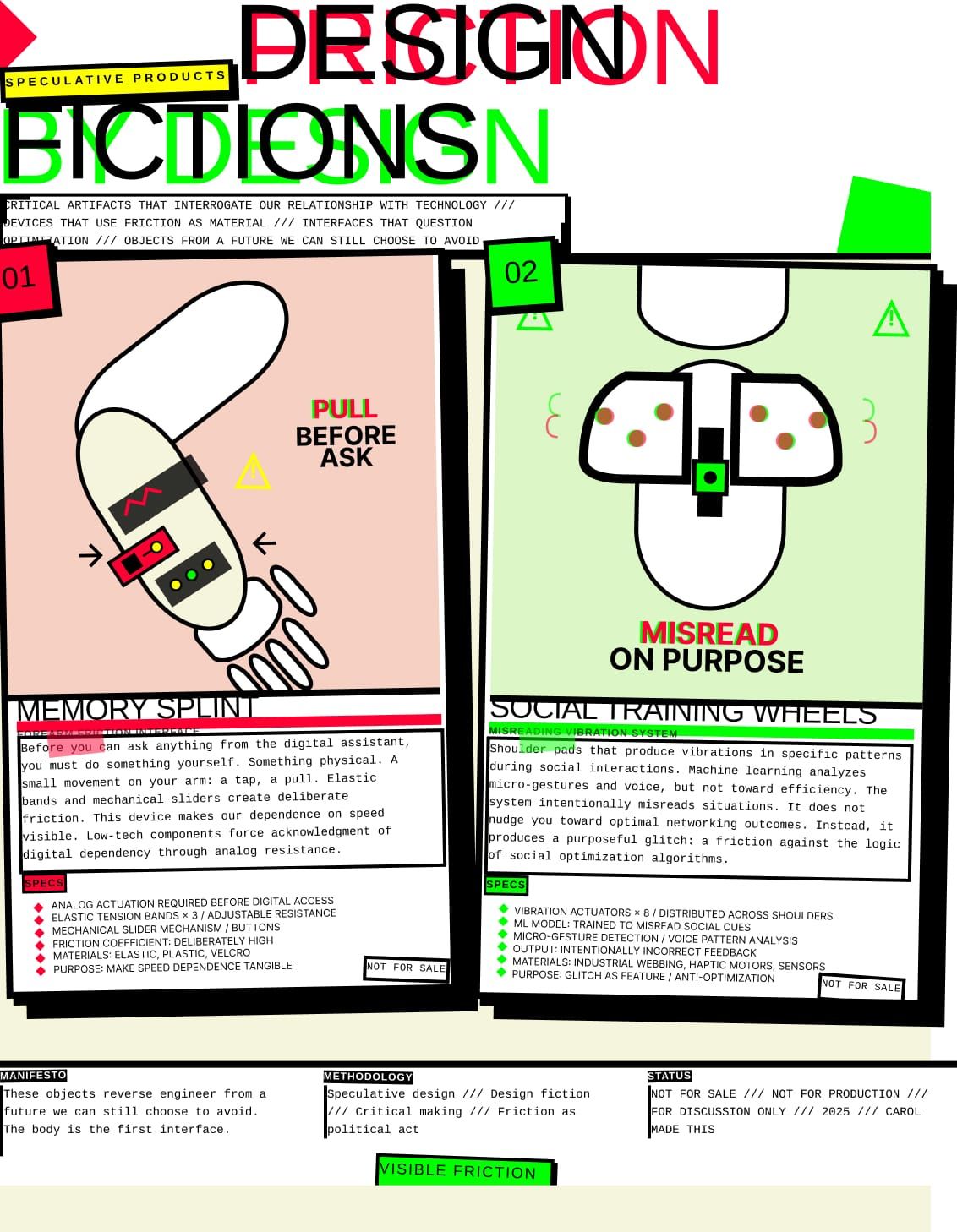
We can reverse engineer from that future and build things in the present. For example we could design a memory splint for the forearm. It might look like a medical device, but it would contain only low-tech components. Elastic bands, and a few mechanical sliders. The rule is simple: before you can ask anything from the digital assistant, you have to do something yourself. Something physical like a small physical movement on your arm, be it a tap or pull. It uses friction on purpose to make our dependence on speed visible.
This design does absolutely nothing “smart” in the usual computational sense. It doesn't record any data and it doesn't run any models to give you "smart" feedback. Instead the physical movement show us how easily we have got used to everything being answered straight away, with no pause or effort to remember it ourselves. This design fiction asks at what point will the instant answers start to replace our own sense and need of remembering something ourselves.
Or we could design social training wheels that function as adult friendship building guide. But with a purposeful glitch. Let's imagine that it would be a set of shoulder pads that produce vibrations in specific patterns during social interactions. The system would use machine learning to analyze micro-gestures and voice but with a different goal than we are used to. It would not nudge people toward the most efficient networking outcome. The pads would instead misread the situation on purpose.
They would buzz when someone seems bored but is actually thinking. They stay still when someone is seething politely to cover their hidden annoyance. Like a glitch. And this is why it works. It works because those wrong signals will interrupt our autopilot. They force us actually to be present and notice what is actually happening in front of us. We stay present and stop outsourcing decisions and judgments to a system that claims to know what is best for us.
These fictional objects are intentionally partial design solutions. They are not created to be actual products. Instead they are created to act as probes that help us materialize uncomfortable questions (Sengers, Kaye, et al., 2005). Through these objects we can ask and explore who gets to decide which bodily cues count as data or features in emotion recognition systems. They also let us wonder what happens when you hand over sensitivity to a third‑party sensor network. And it frees you to as question whose norms get set as the default and whose get treated as noise.
Once a design has to physically sit on a shoulder or be wrapped around a joint, the fantasy of disembodiment collapses. We'll have weight, heat, sweat, hair, clothing, and awkward movements popping up to the scene. There is no abstract user, only specific bodies in specific rooms, and that is exactly where these questions have to be asked.
Materializing the Prosthetic Self
Text can critique the ideology of disembodiment. It can dissect and define metaphors like “meatspace” or “uploading”. It can map the history of our cybernetic fantasies and create relevant taxonomies. All of that is relevant and very needed for a critique. But without an actual material practice the critique risks staying disembodied too. It would just float over the very frictions it aims to describe.
But once you start making prosthetic artefacts, the critique with its arguments gets heavier and more real. That shift matters because the politics stop being abstract. The moment you build something that straps on or hooks and loops into place, you have to decide what kind of body it expects. From there you have to decide what kinds of behaviour it rewards and what kinds of difference it treats as error.
For example, let's imagine designing a focus exoskeleton that locks your elbows every time you want to grab your phone. Very quickly, you must choose whose self-control you are engineering for. You must decide how power is distributed between wearer and the system. After that you have to negotiate consent and deal with reversibility. And all that way before you can start imagining it doing something "smart".
In the design of such objects, a small-scale posthuman society is born and takes shape. We have human bodies, non-human sensors, imperfect actuators, institutional agendas and cultural norms all negotiating inside a single prototype. The prosthetic self is no longer a concept. It is a literal configuration on the table that can pinch, slip, bruise or delight. This is what I mean by materializing the prosthetic self.
Sobchack (2004) writes that wearing a prosthetic leg is a practice of “sensory re‑education” because the body must learn to feel through and with the device. My prototype ideas and approach follows the same logic. They are used as re-education that helps us notice where integration fails, instead of aiming for seamless integration as the end-goal. Because bodies are present and demanding. They refuses deadlines and improvise. Get tired and hurt. People also hack, DIY and decorate. They turn medical devices into fashion or modify cute wearables in protest. In the same way, the prosthetic self is never finished. Nor should it be. It is an unstable assembly that is always close to coming apart, being adjusted, or even remade.
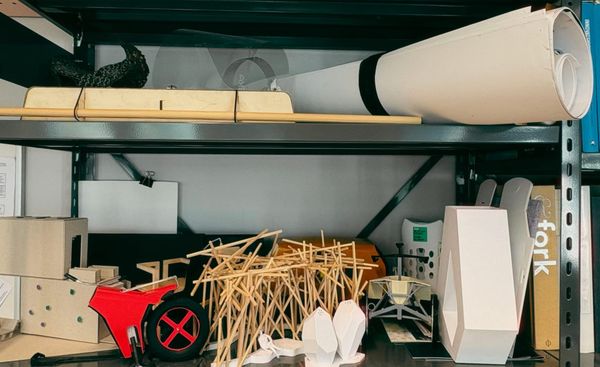
Working this way also helps me to disrupts the polished aesthetics that dominate tech demos. There is always room for visible tape and asymmetric fittings, the signs of working on the solution. These details are not failures but are literally the evidence of negotiation happening. When someone cannot reach their back, the buckle will be moved. If someone uses a wheelchair, the attachment points will be changed. The artefact stores and shows those decisions in its form.
This is exactly why it is also such a powerful site for research. Material practice does not or should not replace critical writing. It just needed to remind designer that critique must also be worn. In a future that keeps trying to forget the body, choosing to build tangible and perhaps awkward artefacts is not just an odd or nostalgic hobby. It is way to keep the body on the agenda of design even when the end-product is not material one.
Keeping the Body on the Agenda
The common fantasy of disembodiment is actually erasing all the differences we have by design. If you are treated or framed only as an information pattern, then your body with all of its specifics will also be treated just as some parameters that are easy to configure but also easy to ignored. The more interfaces rely on that assumption, the more they reproduce and reinforce existing inequalities behind claims of universal access (Irani et al., 2010; Noble, 2018).
However, every time a prosthetic object fails to fit, the designer's “default” human is revealed. Hamraie’s work on "critical access studies" shows that universal design often presumes a normative, able-bodied subject, even when it claims inclusivity (2017). And the misfits just expose the limits and perhaps also the dangers of that default. This is where critical inquiry starts, with those misfits.
For example, take a everyday digital feature and put it it into a wearable, physical form that leaves noticeable marks on the skin after an hour. Notifications become a constricting ring and read receipts become a cooled patch on the neck that gradually warms up. Algorithmic recommendations become a weighted pocket that becomes heavier and heavier when you walk past certain places in the city.
Making these solutions doesn't require extensive resources or expensive technology. No sensors more advanced than those in a toy or any data collection beyond the user’s own memory afterward. High-tech sophistication of the design is not the point or the end-goal. Rather it is what the object makes visible and readable once it is worn and begins to interfere. People wear it and come back annoyed saying things like "I had no idea how much of my day was focused and filled with invisible triggers." Here the artefact does not solve anything. It just makes it harder to look away.
This is where I see interaction design going if it takes the posthuman condition seriously. It shows up in specific and situated experiments. These experiments helps us feel what attachment, extension, or dependency do in everyday life. The goal is to remind us of our bodies and make embodiment the starting point, not to sell the idea of “humans and machines becoming one”.
None of this is sentimental nostalgia of the "good old days" of artificial entities. It is a deliberate step to return to a moment when cyborgs or androids were not polished consumer products. Back then they worked as speculative figures or tools that made social fault lines easier to see. Their wired bodies and visible prostheses may have been awkward and rough, but they did make it clear that augmentation always comes with politics.
So I keep asking myself: what would happen if we treat every new interaction pattern as a potential prosthesis first? For example, what if a recommendation system is a leg, then whose pace does it set? Or if a notification system is a nerve transplant, then who has access to the switch to turn it off? What if a digital identity becomes a chest plate, who decides when you are allowed to take it off or hide it?
These questions sound exaggerated and probably a bit funny, but only until you try to design and build with them. In a future determined to forget our bodies, we can choose to build counter-futures. Not from nostalgia, but because prosthetics expose what seamless interfaces hide: who decides, who benefits, and ultimately whose body matters.
References
Auger, J. (2013). Speculative design: Crafting the speculation. Digital Creativity, 24(1), 11–35. https://doi.org/10.1080/14626268.2013.767276
Bleecker, J., Foster, N., Girardin, F., & Nova, N. (2022). The manual of design fiction. Near Future Laboratory.
Hamraie, A. (2017). Building access: Universal design and the politics of disability. University of Minnesota Press.
Hayles, N. K. (1999). How we became posthuman: Virtual bodies in cybernetics, literature, and informatics. University of Chicago Press.
Irani, L., Vertesi, J., Dourish, P., Philip, K., & Grinter, R. (2010). Postcolonial computing: A lens on design and development. In Proceedings of the SIGCHI Conference on Human Factors in Computing Systems (CHI ’10) (pp. 1311–1320). Association for Computing Machinery. https://doi.org/10.1145/1753326.1753522
Noble, S. U. (2018). Algorithms of oppression: How search engines reinforce racism. NYU Press.
Sengers, P., Kaye, J., & Aoki, P. M. (2005). Reflective design. In Proceedings of the 4th Decennial Conference on Critical Computing: Between Sense and Sensibility (pp. 49–58). Association for Computing Machinery. https://doi.org/10.1145/1094562.1094569
Sobchack, V. (2006). A leg to stand on: Prosthetics, metaphor, and materiality. In M. Smith & J. Morra (Eds.), The prosthetic impulse: From a posthuman present to a biocultural future (pp. 17–41). MIT Press.