“Stalk Me to the End of Love”
What happens when two complete strangers are thrown into a digital fishbowl armed only with their phones and awareness that they are under mutual observation? Do they finally kick back and forget the eyes on the other side of the screen, or do they remain on great alert?

Picture this: a world where the line between communication and surveillance blurs and flips the traditional notion of digital connection on its head. Yes, "there's an app for that", so to speak!
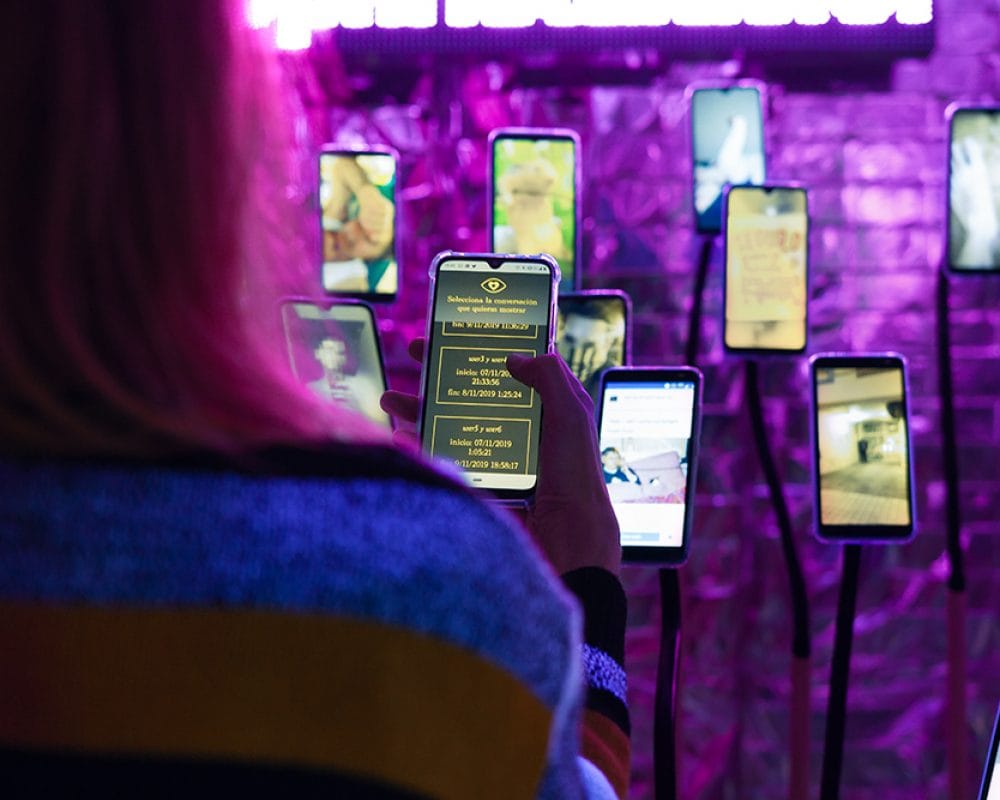
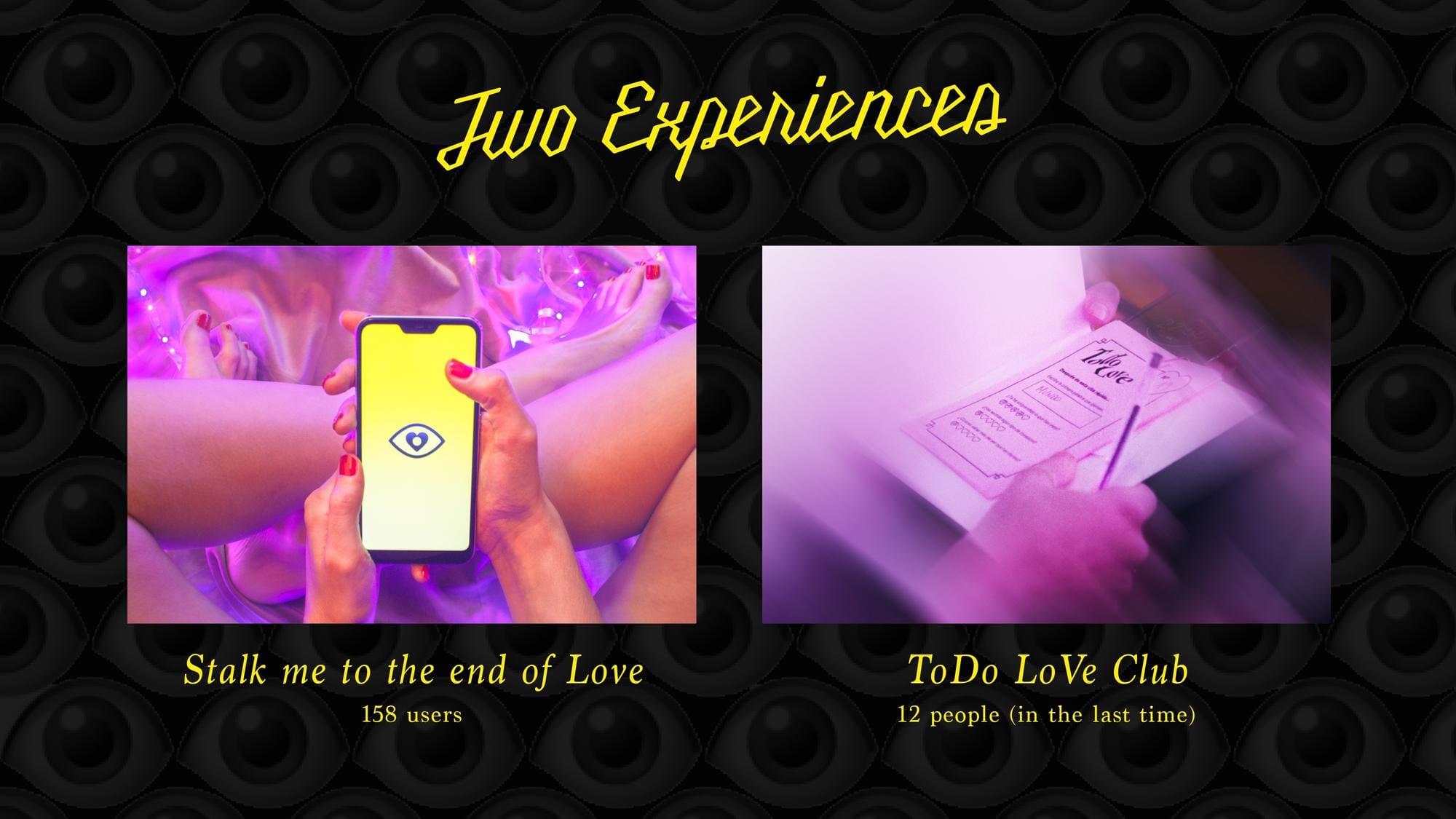
"Stalk Me to the End of Love" project invited people into a speculative space where intimacy was reinterpreted through the lens of technology. And perhaps, by tapping into our underlying curiosity, which often manifests as a desire to observe or "peep" into the lives of others. You know, like that one neighbour peeking you through their window ever slightly hiding behind the curtain or that one classmate form 2nd grade that keeps watching your every single move on social media.
By randomly pairing two strangers, the app created a one-of-a-kind space for peer-to-peer surveillance, resulting in an new and surely uncommon relationship of communication and observation. What a mix, right!? Through this viewpoint, "Stalk me to the End of Love" tests the boundaries of how we interpret closeness in a world when privacy is becoming increasingly elusive.
The experiment prompts us to (re)think how the ever-present eye of digital surveillance influences our daily lives and the connections we make. This kind of peer-to-peer watching makes us think about what it means to be close in the digital age. Is it possible to transform surveillance into a novel, but maybe also potentially harmful, kind of love?
This intriguing concept was presented in the journal Surveillance & Society by Jaseff Raziel Yauri-Miranda and Victoria Ascaso.
Theories
The project was inspired by big ideas such as Zygmunt Bauman's "liquid love," which discusses how modern relationships are often fragile and commodified, and Byung-Chul Han's theories on how digital communication can erode respect and anonymity. By combining these notions, the artists challenge us to contemplate some pretty serious questions:
- What does intimacy look like when it is mediated by technology?
- Can we truly remain anonymous, and mind you, respectful, when we continuously expose our private lives online?
- And can this type of a bizarre, voyeuristic relationship between two people result in true emotional bonds?
Additionally, perhaps I would even sprinkle some MIT professor Sherry Turkle’s Alone Together theory dust here: while the app connects two people, it may also isolate them by replacing genuine interaction with mere observation. I wonder if this type of enforced observation leads to a deeper understanding of the other person or whether it increases feelings of loneliness and disconnection.
Alternatively, we could consider Guy Debord's The Society of the Spectacle, which examines how relationships are commodified or reduced to a spectacle in the digital age. One could argue that in this experiment, strangers do not interact directly but rather perform for each other, resulting in a relationship based on appearance and spectacle rather than actual connection.
Product Design POV
From the perspective of digital product design, "Stalk Me to the End of Love" is indeed an intriguing experiment in user interaction that challenges traditional standards of privacy, intimacy, and communication. And certainly accompanied by a range of value conflicts.
The app's UX appears to be intended to arouse uneasiness and interest, pushing users to consider their relationship with technology and surveillance. The random matching of users introduces unpredictability and I would suggest also tension, two crucial characteristics that generate interest while also prompting critical thought about digital interactions.
The interaction design seems to intentionally blur the line between surveillance and conversation. Unlike traditional social networking apps, where interactions are overt and explicit, this app's design encourages covert observation, which more or less mirrors digital stalking behaviours. By flipping the script on conventional interaction models, the app encourages users to (re)think about the moral implications of their actions.
People may initially be more attentive under constant supervision, but they may grow used to it over time and forget about it. Designing such systems requires safety considerations due to this adaption. As attention fades, the risk of harmful consequences increases.
What's also interesting here is that participants may initially be aware of being watched by the other person, but as they become more relaxed and less self-conscious, they may act more authentically or forget about the monitoring. This transition may reveal how people adjust to constant surveillance and how their privacy and self-presentation change.
The project links with Byung-Chul Han's notion that respect and anonymity cannot coexist in the digital realm. The experiment seems to explore whether respect for others can coexist with surveillance, which results in pushing the limits of what defines polite interactions in digital environments.
But what about behavioural change? Whether intentionally or not, 'Stalk Me to the End of Love' appears to employ, or at least also engage with, several mechanisms aimed to change behaviour.
The app questions accepted social conventions and promotes the development of new ones surrounding digital communication by putting participants in a scenario where they are mutually monitored. This experiment makes one wonder whether close human contacts could turn into regular surveillance, which would force users to rethink their comfort levels and presumptions regarding digital devices.
The app also seems to use operant conditioning, rewarding users with emotions of connection or curiosity for their involvement in observing activities. This reinforcement could help behaviours linked with digital voyeurism to be strengthened, thus participants would reconsider how these feedback loops impact their digital activities.
And at the end of the the day, some could simply feel driven to completely remove all of their dating and social apps, a form of self-preservation in the digital age, you could call it!
Some final thoughts
So, what then happens when two complete strangers are thrown into a digital fishbowl armed only with their phones and awareness that they are under mutual observation? Do they finally kick back and forget the eyes on the other side of the screen, or do they remain on great alert?
Participants may relax with time, which would lead to more real, unfiltered behaviour. This might offer insightful analysis of how people naturally interact when the first self-consciousness disappears. Knowing that someone is observing, perhaps without judgement, might let one feel more comfortable or connected, thus enabling a more real experience.
On the other hand, those who grow used to the monitoring may lose their sense of privacy and possibly forget that they are being watched at all. This can cause questions regarding the disappearance of boundaries and their effect on personal identity. Furthermore, the acceptance of being watched could cause people to be less careful about their behaviour, therefore causing unanticipated consequences.
"Stalk Me to the End of Love" serves as a thought-provoking intersection of art, technology, and social commentary. It is an exploration that challenges everything we think we know about love, privacy, and human connection in the digital world.
Who knew that being watched could be so… enlightening? Are we gradually losing our feeling of self or are we developing into a society that lives and thrives under the gaze of others? It's possible that the answer is hidden somewhere within the glow of a smartphone screen.