Ghosts In The Prototype

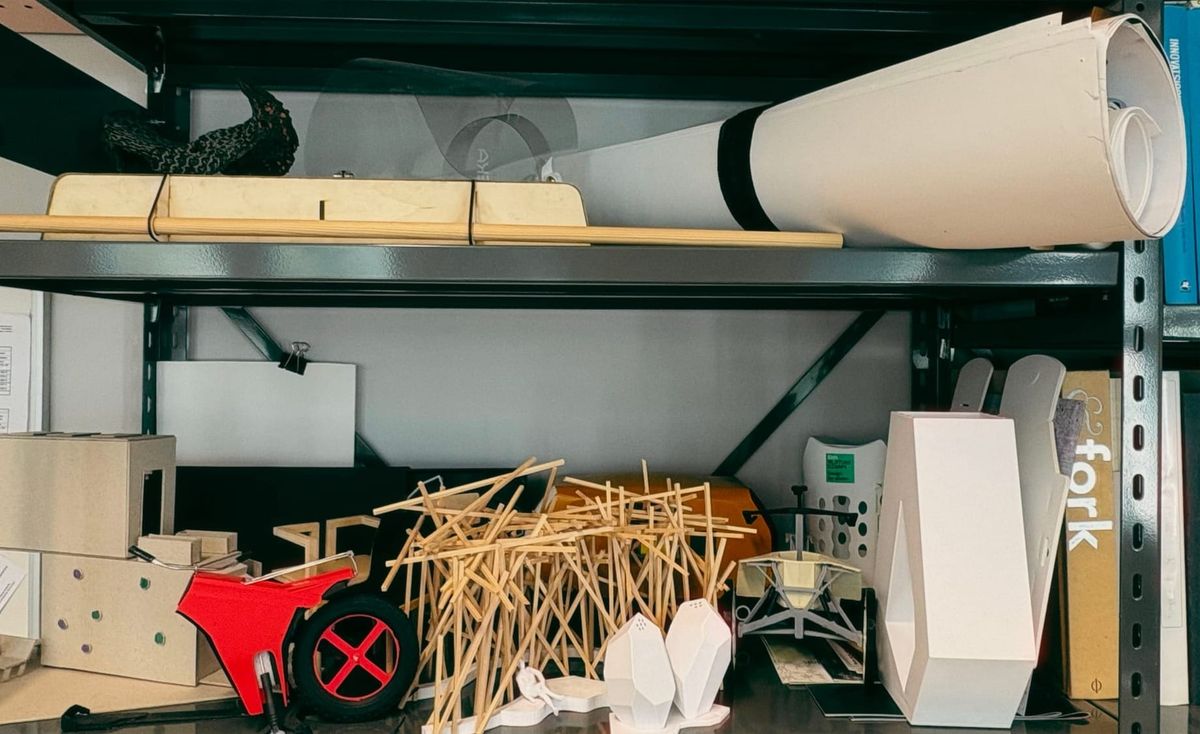
As I was cleaning out the studio at the end of the school year, I started to feel that the studio shelves were breathing. Well, not literally, but if you stand there long enough, it starts to feel that something in the accumulated mass of paper, polycarbonate, wood, electronic bits and pieces, and humming computers seems to inhale and exhale.
Then, suddenly, out of nowhere, a tiny servo twitches. But you know for a fact that its battery died 6 months ago, right after the project presentation. You tell yourself it must be thermal expansion. Or maybe your imagination. It could be lack of sleep from all the all-nighters there. You tell yourself a lot of things there, but what if it's actually real? And there might be "ghosts" in the prototypes?
Every lab has these shelves and drawers and folders on computer drives. Or it could be that cardboard box under your desk with a label "stuff" on it. Yeah, the one where the dead prototypes go. If it's not totally broken or dead, it might get fixed or reused. But that silicon cast that tore at that exact moment when it might have become "something"? Or that circuit that worked exactly 8.5 minutes and then let out a tiny sad puff to never work again?
Nobody fixes them, but nobody throws them away either, not really. And nobody can really explain why. If you ask about it, the answers are most likely to be some sort of mumble about some parts being still useful, or something about not wanting to waste. Makes sense, right, very circular way of thinking.
But if you watch them put that object on that shelf or that box, you might notice something interesting. For a second or so, you might see a glimpse of gentleness. There might even be a pause, like they're replaying the journey they had together. You might even see almost ceremonial gestures there, as if it were a small ritual of some type. As if they are laying something to rest, and maybe a farewell nod.
And rest, it seems, is not what the dead ones do.
Ghosts of Futures That Might Have Been
Our typical prototyping storyline is usually a path from problem to solution, moving through ideation and iteration, step by step, iteratively round and round. It's a process where any success "eats" its alternatives. And all the paths you did not take will sooner or later disappear from your memory.
They become invisible and then slowly turn into nothing. You will forget them. On the other hand, the successful prototype enters the center stage with all the confidence and bravado in the world. It's presented with pride, photographed, maybe published, applauded for sure, and perhaps even manufactured. It's a heroic story about innovation and perspiration! You did it!
But the studio shelves tell another story, a different story.
Do you think most of us would remember the funny-looking silicone mold that broke during our "f**k around and find out" process? No? Probably true, we most likely wouldn't remember much about it, other than what to do differently on our next try. But I think IT remembers.
It stores its wall thickness, draft angles, and even its material's viscosity on that Wednesday early morning when the heater failed, and that exact pressure at which it resisted a bit and then suddenly tore in three different directions. This information is somatic, and this knowledge exists in the object's own material memory. It does not exist in any notes you might have put together. It does not exist in your memory. Not really.
You could write it down, make notes on the failure, and doodle some form studies, but that would all make it abstract or clean it up. It would make the failure seem intentional, part of the design process. It would make it seem like a lesson for sure, or something that enlightened you or motivated you to take another direction and next steps in your build test.
But that broken and torn mold preserves its own "lived" truth. Like the human body with its memories, other materials are no different. Or so I think. So I like to believe that it remembers the moment when the material asserted its own agency and refused to become what you wanted it to be.
Jacques Derrida came up with the idea that he called hauntology. Basically, it's the logic of the ghost, it's the presence of absence. While it's usually applied to history or memory, the way the past never fully disappears and keeps showing up without invitation in the present, I think the idea can also be applied to the futures we create through design and prototypes. In this sense, the successful ones will still become the present, but their alternatives don't just disappear. The failed ones are the ones that actually keep the future open. They sort of hang around, as not fully present but not fully absent either. Not real, but not unreal either.
That's why I think that every test me make, every prototype we create, is also a ghost. They are ghosts of all the futures and possibilities that did not come. But could have. and those possibilities sit inside those ghosts, and our shelves and boxes. These lived truths quietly sitting there remind us that making something is always an ongoing process of negotiations with materials that have their own wills, their own timelines, and also ideas about what they want to become. Or don't want.
These ghosts are quietly haunting us. And what makes this haunting so real is not some abstract idea or romantic musing or delusion. It's the fact that the failed projects and prototypes often do come back later. They often come uninvited, just suddenly pop into our new project. You might be just doing your thing, working on something completely different, but for some reason, your hand still reaches for the torn mold to check a curve. Or you suddenly remember that angle where the silicone failed and decide to change your design around it, even if you're not quite sure why. But you also don't spend too much time thinking about it.
The ghosts we've created do not ask permission to return. And it's a good thing. They just show up at your workbench when you are not looking, and shape what we create next.
Objects That Refuse to Die
The successful prototype will enter the archive of innovation, the portfolio of a designer, the case study to be presented in yet another design event, and of course, the shiny spotlight. Maybe even with a design award or two.
But the failed ones end up on the shelf, in the drawer, or in the box under the table. Spaces that do not seem as valuable as the above-mentioned ones. These counter-archives are important spaces that hold something valuable, something the polished ones cannot hold. Something very precious and beautiful.
When we keep the things that didn’t work out, the dead ones, we’re also keeping something important: the idea that knowing what failed matters just as much as knowing what worked out. Because of this, I think we need better words for this. Calling it "failure" doesn’t feel right, because it's not that. That word also sounds way too moralistic and too final. On the other hand, "archive" feels too official and clinical, with a smell of dust, like something locked away and forgotten.
That's why I'd rather talk about objects that have stopped being instruments but remain evidence. Evidence of work. Of negotiation, maybe even conflict and struggle. Of the body in the workshop, the hand working the material, the eye watching for the exact moment when something becomes something else. Or refuses to.
What should we call them?
The Breathing Shelf
I started this post by thinking that the shelf might be breathing. Now I think it's also listening. When you stand in the studio, and you are surrounded by these remains of your experiments, the dead ones, you just might start to realize that they are not just sitting there collecting dust. They are actually just waiting. They are waiting for someone to spot them and see their unfinished intentions and use the knowledge that was never used.
What do I want to say with all this? Well, simply that keeping old prototypes is a reminder that design rarely moves in a straight line. Every finished project sits on a pile of almosts. Maybe those almosts deserve a place on the shelf. And maybe we should judge a studio by its ghosts?
Or maybe the shelf isn't breathing at all. Maybe this was just a way to postpone cleaning the studio...