Whimsy as Resistance

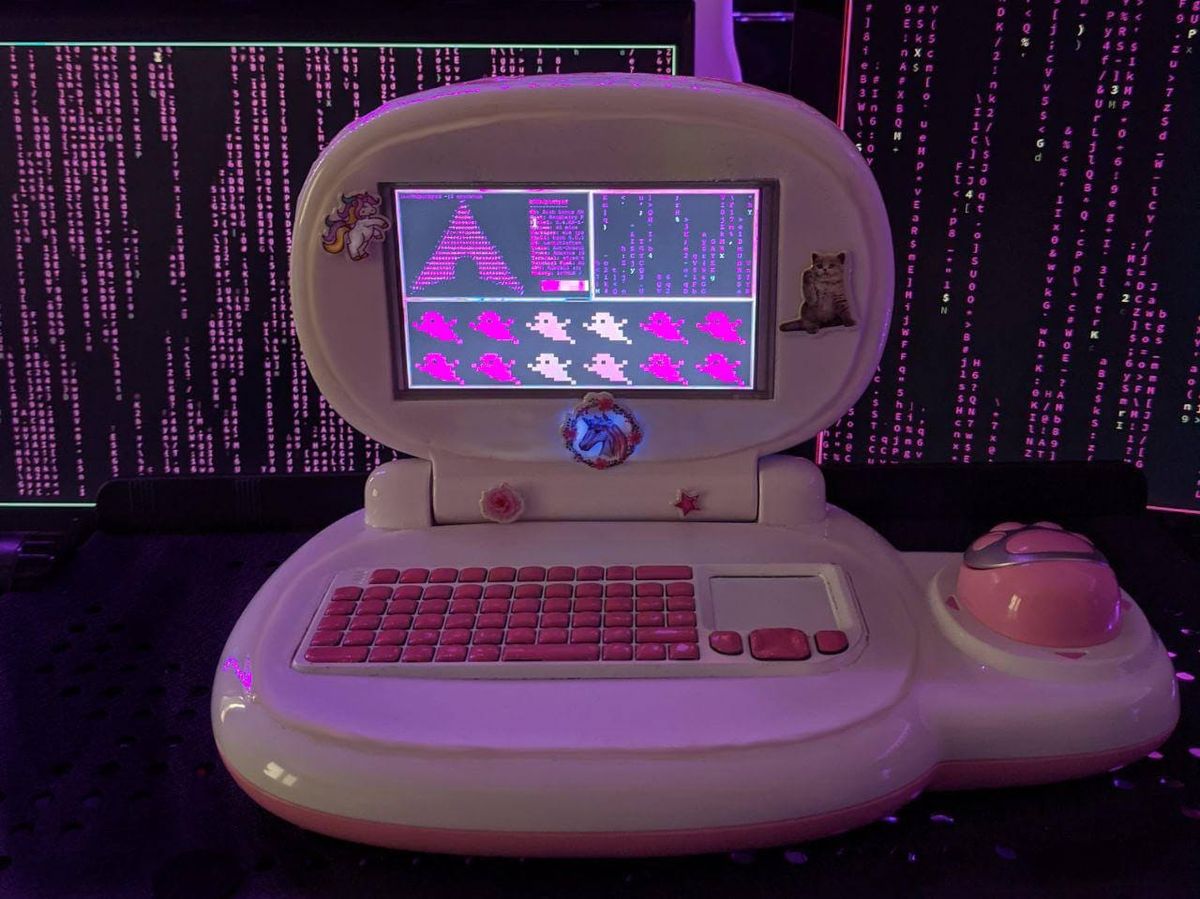
Something really cool has been popping up in electronics and tinkering for a while now. I'm old enough to say that maker movements have come and gone before, and they usually follow a predictable storyline. There is a burst of enthusiasm, you get excited, then a wave of (semi)accessible tools and you join your tribe, then a time of building and doing that, and for some reason, at one point it all starts to slowly fade back into the hands of a small, dedicated niche subculture. Usually it happens when the technology shifts or the novelty wears off.
But this wave feels different for some reason. Or maybe I'm just feeling hopeful with a dash of nostalgia. This time around, all kinds of people from all walks of life and every age group are picking up soldering irons and building their own cyberdecks in their kitchens and living rooms. And "whatever they want" is looking something more than the usual dark, sleek, minimal, strong stuff we've been trained to see as "real" or "serious" tech.
This type of tech aesthetics usually has a very specific look: (matte) black, brushed aluminum, strong angles, clean lines. Think gaming setups, think server rooms, think drones, or any other "serious" piece of hardware ever photographed for tech news. Or even the phone you're holding in your hand right now. This isn't neutral design. It's hegemonic tech aesthetics (Seaborn, 2023), a visual language that is rooted in masculine-coded views and ideals of power, control, and serious purpose. The look says: this is for people who know what they're doing, and those people are men.
Sure, we've had moments of colour and whimsy, think of the colourful iMacs or the whimsical Nokia phones, you know the ones with all the odd shapes and colours. But they were either luxury extras and for very selected few (who could afford them), or marketed "for women"or "for fun". The "lipstick" Nokia was never positioned to be as "real and serious" as the Nokia Communicator. One was kind of a fun gadget and the other was a serious tool. And we all know which one got the respect.
The tech industry has always been biased, we know that. And it has always projected its biases onto its products. Researchers studying the early internet found that designers unconsciously projected "masculine-biased interests on the future user," they called it a masculine genderscript (Rommes et al., 1999). This means that when every "pro" tool is designed to look intimidating and industrial, serious and powerful, and it also sends out a message about who belongs in the room. Who has access and who does not.
But tech doesn't have to look like that. It can be fun. It can be whimsical. Messy. Or feminine. It can be covered in glitter and stickers, if that's what you want. The pink wire still runs a current. It can also serve no purpose whatsoever and exist purely to bring someone joy. And the maker movement is proving this once again.
I've been scrolling through social media platforms and loving the wave of feminine, whimsical cyberdecks popping up everywhere. We have colourful builds with intentionally useless gimmicks, we have ones that are decorated with charms and even embroidery, and we have things built to be enjoyed rather than respected or feared.
I think this is a beautiful rebellion against the masculine culture that still dominates tech and makerspaces. The places where the passion for technology usually becomes "a homosocial 'glue' that makes technology 'sticky' for only a select group of techno-passionate men" (Ottemo et al., 2023). When someone builds a cyberdeck covered in pastel LEDs that plays a cat chasing a butterfly, it looks like a toy, a gimmick. But underneath it is actually running your smart home, monitoring the temperature and adjusting the lights to match the needs of you and your plants.
That is the point. The whimsy and the serious work are not in opposition and they are not excluding each other. They can and do coexist in the same machine. And that really pokes holes in the idea that technology must look black-aggressive-sleek-chromed to be taken seriously. Or do serious work.
Why do I spend time thinking about it, again? Because it seems that we still devalue anything fun-looking, soft, feminine, or whimsical. We automatically tend to think of those builds as some cute side projects. Not something serious for serious tasks. I promise you, you can build a drone or a rat-tracking backpack in a colourful shell, if you want and need, and still be making serious technology. Seriousness is not only something black and metal.
Those same attitudes and biases come from the same place as the broader one of devaluing anything feminine or feminine-coded in our society. Any fun-looking and crafty is still seen as something less technical and less worth taking seriously. The research has been trying to tell us another story, if we would listen to it. For example, work on e-textiles and soft circuits has shown that craft-based, feminine-coded approaches can teach the material more effectively than the standard "hard" tech kits we usually see and use in teaching (Peppler & Thompson, 2024). This is an example of the "soft" approach that actually does the job better.
So why are we still repeating the same old hegemonic tech aesthetics that dictate how serious tech has to look? Even today we see the girls' coding and building clubs reinforce this aesthetic. As if afraid that anything else would render their work less valuable, less serious. The intention of those spaces is good for sure, but the message they send out is still, well, wrong. It is still saying that come join us, but do it our way. This works against the very idea of such clubs and spaces, to say the least. As one study on maker cultures found, the "masculine characteristics of maker spaces create challenges for feminine identity construction and expression" (Marshall & Rode, 2018). And queer tech? Still mostly invisible, if you're not part of it.
What I want to say is that aesthetics aren't just surface-level or something trivial. The way things look and feel, the way we design them, also decides or even dictates who feels welcome and who gets to say what technology is for. If it's homogeneous, looking only one way, then it also invites one kind of person to create and use it. It's a closed and privileged club. When we open this up and expand the visual and functional vocabulary of what we create, when we allow colour and glitter to excist next to chrome, whimsy with utility, then we also make it more accessible. We make it more creative and perhaps also more honest. And then we actually really honestly acknowledge the diversity of people who make it and use it.
The maker movement has always given us "permission" to build whatever we want and use our free will to go crazy and blow sh*t up if we want. Now we need to actually do that, again. So go out there and build ugly, build soft, build fun AND serious, build kickass, build something truly yours!
References
Marshall, A., & Rode, J. A. (2018). Deconstructing sociotechnical identity in maker cultures. Proceedings of the ACM on Interactive, Mobile, Wearable and Ubiquitous Technologies. https://doi.org/10.1145/3196839.3196855
Ottemo, A., Berge, M., Mendick, H., & Silfver, E. (2023). Gender, passion, and 'sticky' technology in a voluntaristically-organized technology makerspace. Engineering Studies. https://doi.org/10.1080/19378629.2023.2203396
Peppler, K., & Thompson, N. (2024). Tools and materials as non-neutral actors in STEAM education. Journal of the Learning Sciences. https://doi.org/10.1080/10508406.2024.2380694
Rommes, E., van Oost, E., & Oudshoorn, N. (1999). Gender in the design of the digital city of Amsterdam. Information, Communication & Society. https://doi.org/10.1080/136911899359510
Seaborn, K. (2023). Interacting with masculinities: A scoping review. Proceedings of the 2023 CHI Conference on Human Factors in Computing Systems. https://doi.org/10.1145/3544549.3585770