The MA Curriculum That Doesn't Exist Yet. But should.

I've been having this recurring thought or a dream. Or maybe not a dream exactly, but more like a signal popping up from another frequency. You know, like when you're half-asleep and a clear understanding arrives from somewhere, it's fully formed, and it's too precise to be a dream? That kind of thing.
The thought goes like this: What if the future already arrived, but it sneaked in through the gaps in the walls instead of the front door, and design didn't notice because it was too busy moving around the furniture?
Mind you, design is doing it absolutely beautifully, and with incredible taste. The chairs have never been more ergonomic, the interfaces never more frictionless, the systems never more user-centered. With all the scalability magic, growth hacks, and whatnots. But the walls have changed. Materials have started to think. Environments have begun to negotiate on their own terms. The boundary between organism and infrastructure has become a design decision.
So I took a moment or two and sat with that thought for a while. And then did what any self-respecting designer and academic would do when it's 2 a.m. and your entire discipline starts flickering like a bad signal. Yes, I started building a curriculum. Not a real one, at least not yet. An imaginary one.
I decided to put down everything that doesn't need to answer to accreditation boards or enrollment plans, and it for sure does not answer to industry advisory panels asking whether graduates will be "workplace ready".
It is a program that answers a single and arguably more urgent question: What should a designer know how to do if the future is nothing like the present?
What follows is that curriculum. It is speculative. It is serious. And I hope it is also slightly unhinged in exactly the right ways!
So Here It Is
We are living through a new era of design that is shaped by intelligent systems, synthetic materials, planetary pressures, and hybrid forms of life. But most design education still acts as if the discipline's job is to make things more usable, more beautiful, more efficient. And more lucrative for sure. As if we're still designing for humans in environments we understand, using technologies we control.
We're not.
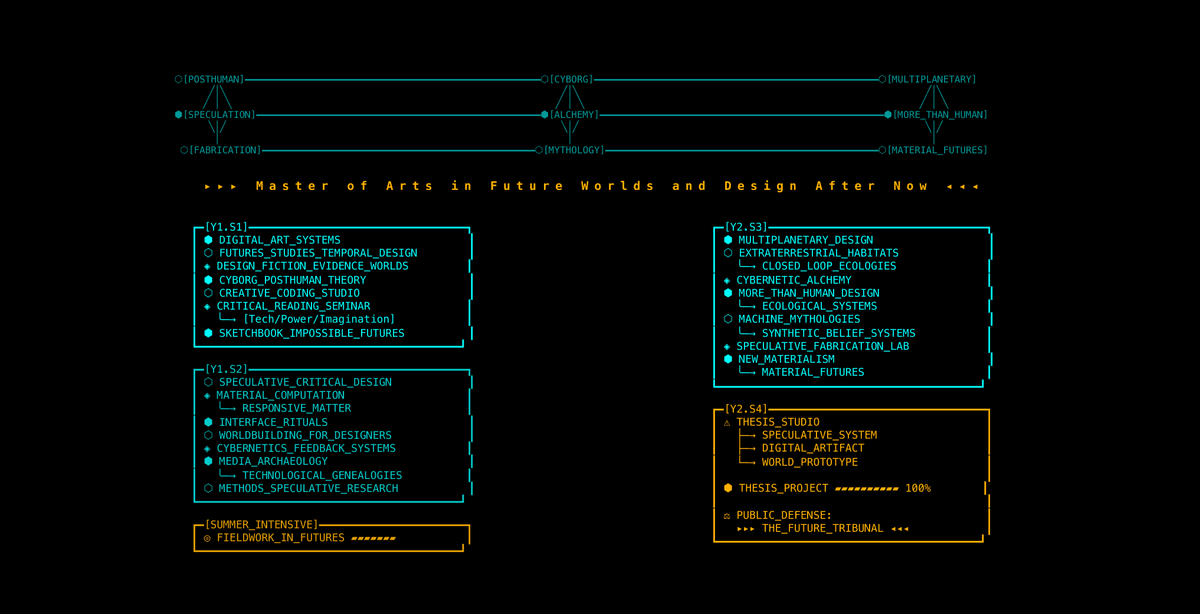
Let's call it for now the Master of Arts in Future Worlds and Design After Now, where design is treated as a practice of constructing worlds, behaviors, protocols, and speculative systems. Not metaphorically, but literally.
Students work at the intersection of digital art, computation, theory, and critical making. They design with code, simulation, fabrication, sensing, narrative, and emerging technologies. And they do all this while also developing the conceptual depth needed to imagine futures that are technically precise and absolutely impossible to look away from.
The program is grounded in futures design, design fiction, speculative and critical design, cyborg and posthuman theory, cybernetics, media archaeology, new materialism, and more-than-human, planetary, and multiplanetary thinking. Yes, that's a mouthful. But it's all needed to really ask what technologies can do. To ask what kinds of beings, environments, economies, and forms of consciousness they might produce. And to ask what responsibilities come with inventing them and creating for them.
This is not meant to be a general creativity program, absolutely not. It is for people who can code, model, build, write, theorize, and prototype across systems. It is for people who are willing to work with enormous amounts of ambiguity at a high level of technical craft. The assumption is that the student arrives with enough fluency and skills to dive deep, not splash around widely. You don't come here to discover your creative voice. You come here because that creative voice has been saying things that scare you, and you need a place to unleash it. Welcome!
The Curriculum
Here is a high-level view of the whole program. It is something, it is a lot. And it should be. A curriculum designed for a world that doesn't exist yet has no business being an entry-level art club or easy extension of your random BA. This one is built to exceed the container, yours and its own.
Year 1, Semester 1
- Introduction to Digital Art Systems
- Futures Studies and Temporal Design
- Design Fiction and Evidence Worlds
- Cyborg and Posthuman Theory
- Creative Coding Studio
- Critical Reading Seminar, Technology, Power, and Imagination
- Sketchbook of Impossible Futures
Year 1, Semester 2
- Speculative and Critical Design Studio
- Material Computation and Responsive Matter
- Interface Rituals
- Worldbuilding for Designers
- Cybernetics and Feedback Systems
- Media Archaeology and Technological Genealogies
- Methods of Speculative Research
Summer Intensive
- Fieldwork in Futures
Year 2, Semester 3
- Multiplanetary Design
- Extraterrestrial Habitats and Closed-Loop Ecologies
- Cybernetic Alchemy
- More-than-Human Design and Ecological Systems
- Machine Mythologies and Synthetic Belief Systems
- Speculative Fabrication Lab
- New Materialism and Material Futures
Year 2, Semester 4
- Thesis Studio, Speculative System / Digital Artifact / World Prototype
- Thesis Project
- Public Defense: The Future Tribunal
Did I take the time to write out the description for every course here? I sure did, just in time to see the sun rise, and replaced my night coffee with a fresh cup of morning coffee. Perhaps there will be another post on that. I regret nothing. That post is coming. Maybe I think some more, and there will be some additions, maybe Immersive Systems and Spatial Media? Who knows what the dream is dreaming of!
So What Do They Actually Build
You probably think of beautifully rendered concept sketches on the wall, accompanied by some academic writing, then a crit and applause? Naah, not the point, that's not what happens here. What comes out of here has a pulse and teeth. It produces functioning fragments of futures that don't exist yet.
A thesis research from this program might be:
Developing a working model of a cybernetic governance system for an urban commons at a neighborhood scale. Maybe it would be critiqued through the lens of Stafford Beer's viable system model and Octavia Butler's Earthseed. You know, the stuff for highly volatile and complex environments.
Or creating an adaptive textile that responds to hormonal fluctuations. It could be designed in conversation with trans and intersex communities, and be grounded in a theoretical framework drawn from Paul B. Preciado's pharmacopornographic theory and situated within a speculative healthcare economy. Yes, I did some quick research.
The point is that they are multi-layered and technically functional provocations. They are built, and they work. And they argue against or for a future world.
Who This Is For
The most obvious answer is people like me. This program is for designers, artists, engineers, and theorists who have hit the edge of their current practice and want to keep going, somewhere unknown. People who suspect that the most important design problems of the next century (or next year, really) won't look like design problems at all. They'll look like philosophical crises, ecological emergencies, ontological negotiations with things we haven't decided are alive or present yet.
And it is for people who want to build things that are strange, precise, and necessary. It's for people who are not afraid of that type of conversation.
Final Thoughts From My Twilight Zone
I keep coming back to that signal and half-asleep frequency. The signal that says the world is already shifting a lot and most of our institutions haven't noticed yet. Ot at least we are not really acting on it. We keep training people for the last "paradigm", and then wonder why they feel lost, and then blame them for not being "adaptable enough" or just "not ready for the workforce". Or just blame Gen Z (and then Alpha) for lack of interest in "working" or whatever we think they're lacking.
What if we instead created a place where being lost was the main prerequisite? Where the curriculum itself was a kind of speculative object? Sort of a prototype for an educational future that doesn't exist yet, but deep down feels like it should?
That's what this is. An imaginary degree. A signal from a future that hasn't decided how exactly to arrive.
Would you apply? I'd really like to know. Not because I'm building it tomorrow, but because every program existing now was imaginary at one point. And somebody went first.